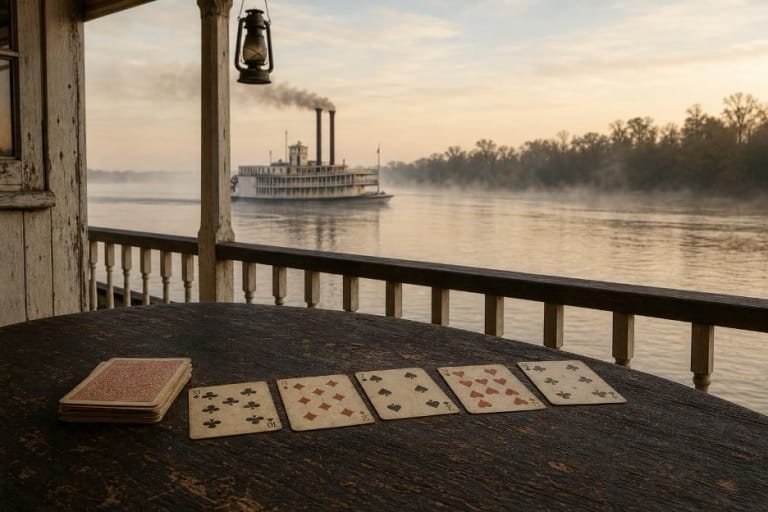
The Helen M’Gregor was crowded when actor Joe Cowell boarded near Louisville, Kentucky, on a wet December night in 1829. He was heading toward New Orleans. During the journey, he watched four fellow passengers play poker, keeping their cards concealed as the wagers climbed.
Cowell published his account in 1844, leaving a record of poker during its early years on American rivers. Nearly two centuries separate his journey from a modern poker table reached through a tooniebet login. Across that time, the game acquired larger decks, new rules and digital versions. Some of the choices and card combinations familiar to players today took shape along the way.
A Port City Connected by Water
New Orleans offered fertile ground for a game to spread. Merchants and travelers passed through its port, where goods arriving from inland waterways changed hands before continuing by sea. French cultural influence remained strong after the Louisiana Purchase brought the city into the United States in 1803.
Card-game historian David Parlett places poker’s early development in the territory around New Orleans, particularly its gambling saloons and Mississippi steamers. The boats connected places where people could learn a game, carry it elsewhere and introduce it to another table.
Steam travel expanded those connections. The National Park Service’s history of the Mississippi Delta records that the sidewheeler New Orleans traveled from Pittsburgh to its namesake city in 1811. A year later, it began fairly regular service between New Orleans and Natchez.
Steamboats became major cargo carriers, and river communities including Memphis, Vicksburg and Baton Rouge grew. Riverboat gambling developed during the 1830s. Poker spread north along the Mississippi and west with the frontier, following the movement of passengers and trade.
Four Players Aboard the Helen M’Gregor
Cowell’s story shows what a card game looked like within that busy river traffic. He boarded at Shipping Port, about two miles below Louisville, where the heavily laden Helen M’Gregor waited with its passengers. In his memoir of the journey, published by Harper & Brothers, Cowell described players using aces, kings, queens, jacks and tens. These ranks made up the 20-card pack associated with early poker. Dealt among four players, they supplied five cards to each person and used the entire deck.
Pairs, three of a kind and four of a kind were part of the game. Players concealed their cards while considering the bets around them. Cowell also described card manipulation, placing cheating alongside the betting and bluffing in his account. That compact pack would soon give way to a game with more room for players and possibilities.
More Cards, More Decisions
During the 1830s, poker increasingly adopted the full 52-card deck. Parlett connects the change with accommodating more players and developing features such as the flush and the draw. A flush consists of five cards of the same suit. Drawing lets a player replace selected cards in an effort to improve a hand. With additional cards available, poker could offer more combinations and another decision after the initial deal.
The game continued moving beyond the rivers. Soldiers played during the Civil War, and poker became a fixture of frontier saloons in the 1870s and 1880s. Later variations brought their own regional connections.
Texas Hold’em is one example. In 2007, the Texas Legislature formally recognized Robstown as its birthplace. Hold’em combines cards held by individual players with community cards shared across the table. That arrangement also appears in casino games built around comparisons with a dealer.
What Survives at a Digital Table?
Casino Hold’em uses two personal cards and five community cards, from which players select their best five-card combination. ToonieBet, which serves Canadian players outside Ontario, lists more than 5,000 games, with table and live dealer formats among them. They compete against the dealer, with the hand rankings providing the basis for comparison. Video poker follows the older draw idea. A player receives five cards, chooses which to keep and replaces the rest with cards selected by software. The completed hand is assessed against a paytable that sets the payout for each qualifying combination.
These games involve financial risk. Gambling is an adults-only activity subject to local age and location rules. Keep spending within an affordable limit, set a time limit and seek support if gambling becomes difficult to control. The setting has changed considerably since Cowell traveled south. Yet the five-card hand still provides a connection: cards concealed, combinations assessed and decisions made before the result is revealed. Those familiar details carry a piece of poker’s riverboat history into its modern forms.